Illuminated Bathroom Mirrors Explained
Discover how to choose illuminated bathroom mirrors for your UK home. Learn about IP ratings, electrical zones, lighting quality and expert installation tips.

Most guides on illuminated bathroom mirrors start with style, finish with price, and leave the hard part to chance. That's backwards. In a UK bathroom, the mirror's position, the room's electrical zone, and the quality of the light on your face matter more than whether the frame looks sleek in a showroom.
A mirror that looks perfect online can be wrong for your wall, your wiring, or your daily routine. The right choice has to work as a product and as a fixed electrical fitting, which means safety and lighting performance need to be judged together, not separately.
Why Product Ratings Alone Do Not Guarantee Safety
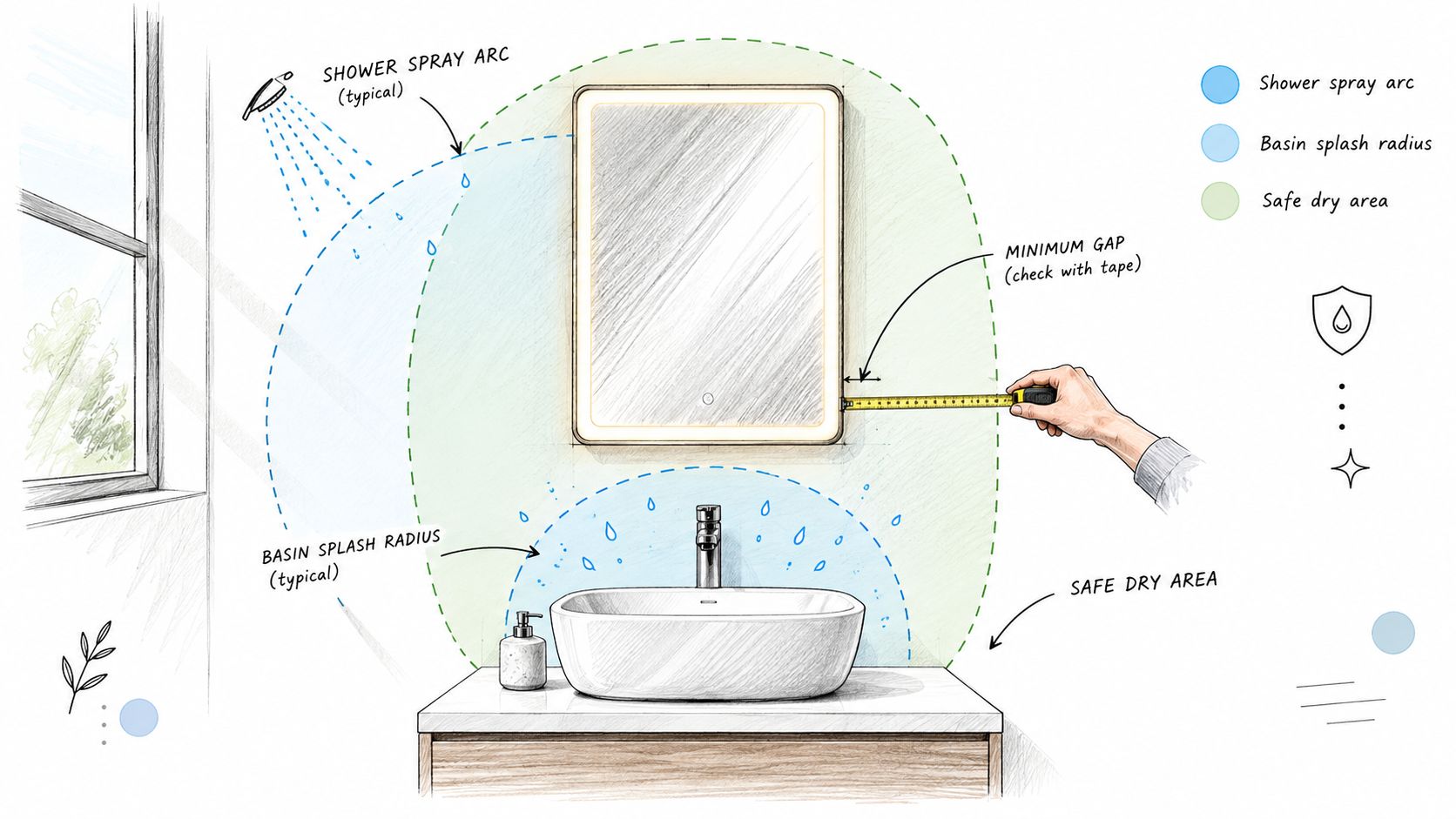
A bathroom mirror can carry a good IP rating and still be wrong for the wall it is fixed to. The safer question is where it will sit in the room, because that decides the electrical zone, the wiring method, and the protection the fitting needs. NICEIC explains that bathroom installations are divided into Zones 0, 1, and 2, and those zones control what can be installed where. NICEIC bathroom electrical guidance
The wall matters as much as the mirror
Zone 0 is inside the bath or shower tray. Zone 1 runs above that area to the highest fixed shower head, or 2.25 metres from floor level, whichever is higher. Zone 2 extends a further 0.6 metres beyond Zone 1. A mirror above a basin can still fall within Zone 2, so a product described as “bathroom-safe” is not automatically suitable for every position. NICEIC bathroom electrical guidance
Practical rule: measure the room first, then choose the mirror. Reversing that order causes most avoidable mistakes.
That matters just as much on a small retrofit as on a full refit. A basin close to a shower screen, for example, can place the mirror in a zone that changes the fixing and wiring rules, even if the mirror itself looks like a standard decorative fitting. A gap that seems generous on paper can shrink fast once tile thickness, splash reach, and the exact mounting height are checked on site.
Traditional wall switches are not permitted in Zones 0, 1, or 2, because wet hands raise the shock risk. UK work in dwellings can also fall under Part P when it is notifiable, so the installation may need Building Control notification or certification. A competent electrician should check the circuit, the product, and the cable route before anything is fixed to the wall. For a renovation team that handles this kind of detail day to day, see Meet the team behind the renovation work.
Comparing Backlit and Integrated LED Designs
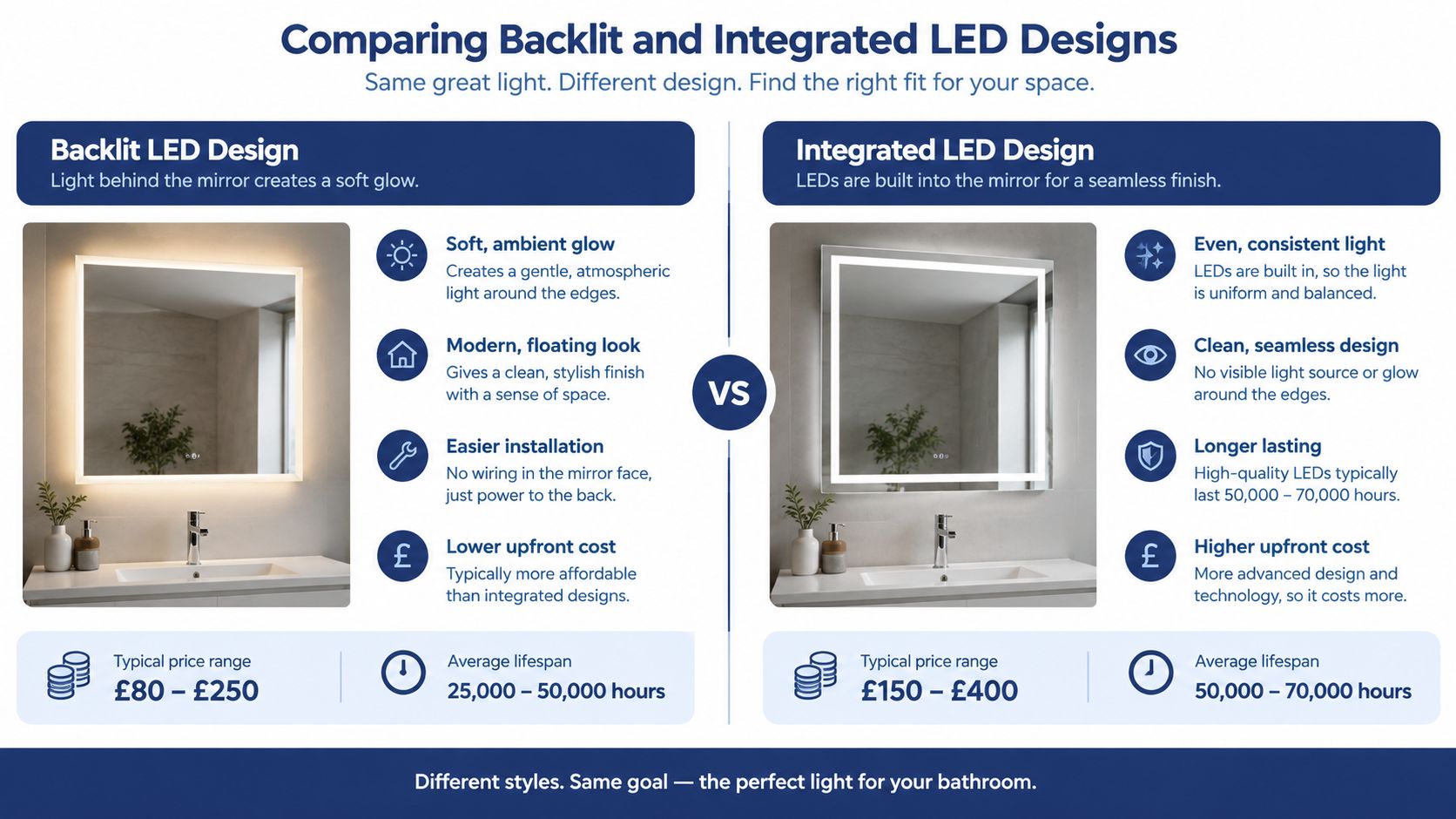
Backlit and integrated LED mirrors can both look sharp, but they behave differently in real bathrooms. The better choice depends on whether you want soft ambience, clean task light, or both. I've seen homeowners pick a mirror for its showroom glow, then find it's wrong for shaving because the light lands behind the glass instead of on the face.
Backlit mirrors suit atmosphere first
A backlit mirror throws light onto the wall behind it. That creates a softer halo, which works well in a bathroom where the mirror is part of a calmer, spa-like look. The light is indirect, so it tends to feel less clinical and can be kinder in compact spaces where a bright front-facing source would feel harsh.
That same softness can be a limitation. Backlighting often looks stylish, but it doesn't always give the crisp facial definition needed for shaving, tweezing, or precise makeup work. If the wall finish is dark, textured, or uneven, the glow can also look less controlled than expected.
Integrated LED mirrors are usually better for grooming
Integrated LED designs place the light source within the mirror unit itself, often around the edges or in a top and side arrangement. In practice, that usually gives a more direct, usable light on the face, especially when the LEDs are diffused properly and mounted to reduce shadows under the eyes and chin. A mirror with side lighting or balanced edge lighting is usually more useful than a single top strip.
A mirror that flatters the room but shadows the face is the wrong mirror for a bathroom used every morning.
The trade-off is simple. Backlit mirrors are often stronger on mood, while integrated LED mirrors are usually stronger on task performance. If the bathroom is mainly used for quick washes and you want a softer visual effect, backlighting can make sense. If the space doubles as a grooming station, integrated lighting is usually the more practical choice.
The detail that separates good from poor design is diffusion. Harsh LED points, especially along one edge, can create glare in the eyes and a washed-out look on skin. Well-designed integrated mirrors spread the light more evenly and feel far less tiring during daily use.
Navigating UK Electrical Zones and IP Requirements
Bathroom electrics in the UK are built around fixed boundaries, not guesswork. Once you understand the zones, the rest becomes easier to specify. The core point is that a mirror placed above a basin may be fine in one position and wrong in another, even if it's the same product.
Here's the practical breakdown:
| Zone | Boundary Definition | Minimum IP Rating | Additional Requirements |
|---|---|---|---|
| Zone 0 | Inside the bath or shower tray | IP67 | Equipment must be suitable for immersion conditions |
| Zone 1 | Above the bath or shower to 2.25 metres | IP44 | 30 mA RCD protection required |
| Zone 2 | The additional 0.6 metres beyond Zone 1 | IP44 | Position still needs checking against splash exposure |
The same mirror can be acceptable or unacceptable depending on where it lands in that table. Crosswater's bathroom zone guidance notes that mirrors above basins are often close enough to a bath or shower to fall into Zone 2, so the declared IP rating and the connection method have to match the measured layout. Crosswater bathroom electrical zones
Check the room, not just the product label
The Institution of Engineering and Technology states that a 230-volt socket outlet must be at least 3 metres horizontally from the boundary of Zone 1. It also states that 230-volt fittings above a bath or shower need at least IPX4 protection, which means resistance to water splashes from any direction. Bathroom safety requirements and fitting guidance
That's why a site survey matters so much during renovation. The installer needs the distance from the bath, shower, and basin, plus the likely path of spray during use and cleaning. A mirror near a shower may also need a higher degree of protection where water jets are likely during cleaning, so the final choice shouldn't be made from a catalogue alone.
Electrical Safety First adds another useful rule, unenclosed light fittings should be out of reach of someone who is using, or still wet from using, a bath or shower. That human-factor detail is easy to forget, but it's often the difference between a comfortable installation and a risky one.
What a compliant specification usually includes
- The right IP rating: usually IP44 or higher where the mirror is within the relevant zone.
- RCD protection: especially where the circuit supplies bathroom locations with a bath or shower.
- Suitable switching: pull cord, remote, or another arrangement outside the wet zone.
- Qualified verification: final checking by a competent electrician under BS 7671.
Evaluating Light Quality for Daily Grooming
A mirror can be electrically compliant and still be a poor daily tool. The first thing many users notice is brightness, but brightness alone doesn't tell you whether the mirror will help with shaving, skincare, or makeup. What matters is how much usable light reaches the face, how evenly it spreads, and whether the LEDs show skin naturally.
Lux tells you what the eye actually receives
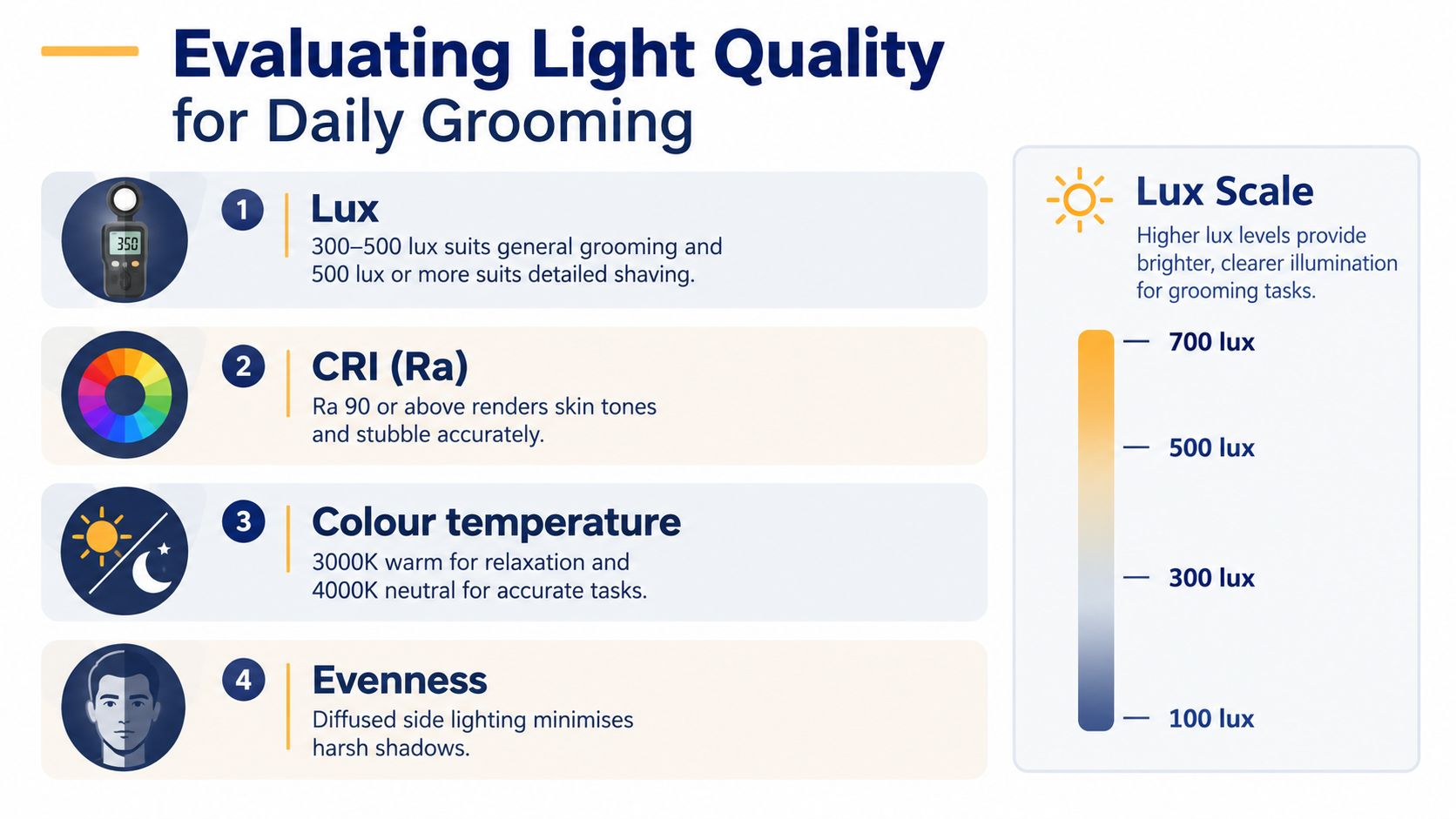
Lux is the light arriving on a surface. That means a mirror's lumen figure, on its own, doesn't tell you much about performance at face level. UK government accommodation guidance, citing CIBSE LG9, suggests approximately 100 lux for toilets and 150 lux for bathrooms, while NHBC guidance recommends 250 to 300 lux for bathroom floors and specifically calls for good task lighting around mirrors. UK accommodation lighting guidance
For grooming, the useful question is not “how bright is the mirror?” It's “does the face get even, glare-controlled light at the point where I'm standing?” Mirror height, beam spread, diffuser design, wall reflectance, and distance all affect that result.
Colour rendering changes how truthful the mirror feels
Geberit UK recommends an Ra value above 90 for natural skin-tone reproduction. That matters because poor colour rendering can make complexion, stubble, and makeup look slightly wrong even if the bathroom is bright enough. Geberit lighting guidance
Good grooming light should reveal detail without flattening the face.
That's why evenly diffused vertical lighting usually outperforms a single top strip. Top-only lighting can throw shadow under the brow, nose, and chin, which is the opposite of what you want when you're trying to see the actual line of a beard or the blend of foundation.
Temperature and evenness shape comfort
Colour temperature also changes how the mirror feels to use. Warmer light tends to suit relaxed evening use, while neutral light is usually more truthful for tasks. If the mirror is for daily shaving or makeup, evenness and colour accuracy should come before decorative glow.
A sensible specification is straightforward. Choose an IP-suitable mirror with stated or measured output, Ra90-or-better LEDs, and a diffuser that smooths the light instead of spotlighting parts of the face. Then test it in the room, because a mirror that looks fine in a showroom can behave very differently once it's mounted above real tiles and basinware.
Planning the Physical Installation and Wiring
The cleanest-looking installation is rarely the easiest one to fit. Hardwiring the mirror gives a neater finish, but it also means the electrician has to plan cable routes, access points, and protective measures before the wall is closed up. A plug-in unit is easier in a straight retrofit, but it can leave a visible lead and is often less satisfying in a finished bathroom.
Concealed wiring is where many renovations get awkward. Once tiles are in place and a waterproofing system is complete, chasing for a new cable can mean avoidable damage and extra reinstatement work. That's why a mirror should be picked alongside the electrical plan, not after the tiling is done.
Switching and protection have to suit the wet room
Traditional wall switches are not permitted in Zones 0, 1, or 2, so the control method needs to be chosen with the bathroom layout in mind. Pull-cord switching, remote controls, or a correctly located switch outside the wet area are the usual practical answers. The circuit also needs the right protection, which is why RCD provision matters so much in bathroom work.
If the electrician has to improvise the switch location on the day, the design wasn't finished early enough.
That's the reality of most problem jobs. The mirror arrives, the wall is tiled, and suddenly the team discovers the planned cable route clashes with pipework, a stud, or a waterproofing layer. A proper survey avoids that mess because it checks where the supply can come from, how the mirror will be isolated, and whether the wall can accept the fitting without compromising the finish.
Waterproofing and cable routes need to be thought through together
The neatest solution is usually the one planned before the first tile goes on. If cables need to pass through a wet zone, the installer has to think carefully about sealing and continuity so the wall build-up stays sound. If you're also changing shower or basin positions, the electrical layout may need to move with them.
Waterproofing and seal detail matters before the mirror goes up
A qualified electrician should confirm the circuit, the isolation method, and the compliance paperwork. The homeowner should ask one simple question before buying the mirror, how will this be fixed, powered, isolated, and inspected once the room is finished? If that answer isn't clear, the product isn't ready for the project.
Coordinating Your Bathroom Renovation Project
An illuminated mirror is rarely the first item that should be ordered, because it depends on everything around it. The basin position, wall finish, lighting circuit, waterproofing, and mirror height all affect the final result. If those parts are handled separately, you end up with ugly compromises, extra visits, and sometimes rework that could have been avoided.
The best bathrooms are built from a single coordinated plan. Plumbing sets the basin and shower positions, tiling fixes the wall build-up and reveal lines, and electrics determine where the mirror can safely sit. When different trades work from different assumptions, the mirror often becomes the thing that exposes the mismatch.
A site survey should come before the purchase
That survey should check whether the existing lighting circuit is suitable, whether concealed wiring can be added without damaging the room, and whether the mirror's planned position lands in Zone 1 or Zone 2. It should also confirm whether the basin sits close enough to be treated as a splash-sensitive area. One missed measurement can force a product swap or a visible compromise.
Good renovation sequencing saves money because it prevents rework, not because it chases the cheapest mirror.
That is especially true in occupied homes and rental properties, where delays are disruptive. A coordinated contractor can sequence electrical work, tiling, and finishing in the right order, which keeps the room usable sooner and avoids opening finished surfaces twice.
Keep compliance documents with the job file
The final installation should leave behind more than a working mirror. The homeowner or landlord should keep the relevant electrical certification, product information, and any notes about circuit protection or isolation method. If the bathroom is sold, let, or checked later, that paperwork helps show the work was done properly.
Leak repairs and bathroom checks often reveal the cost of poor sequencing
A well-planned illuminated mirror installation should feel invisible in use. It should light the face clearly, sit safely in the room, and fit the bathroom without awkward cables or afterthoughts. That only happens when the mirror is specified as part of the renovation, not as a last-minute accessory.
Seby Bathroom Renovation handles bathroom projects as a whole, which is exactly what illuminated mirrors need. If you're planning a new bathroom or a retrofit in Folkestone or Kent, visit Seby Bathroom Renovation to discuss a compliant installation that fits the room, the wiring, and the way you use the space.
Generated with the Outrank app