Brushed Bronze Shower Head: A Buyer's Guide for 2026
Find out what makes a brushed bronze shower head a smart pick: finish care, durability, water pressure and fit, plus tips for choosing the right one.

A brushed bronze shower head is chosen for style, but its real performance comes down to flow rate, system compatibility, and maintenance. In UK terms, the difference between a standard shower head at 10 to 15 litres per minute and a lower-flow model at about 6 litres per minute can be the difference between a bathroom that feels thoughtful and one that drives callbacks for weak spray or wasted water.
A lot of Folkestone homeowners start with the look. They want warmth where chrome feels cold, and they want a finish that works with wood, stone, or soft neutral tiles. Then the practical questions land, will it suit the existing shower, will it cope with local water, and will it still look good after a few months of use.
Choosing a Brushed Bronze Shower Head
I see the same pattern on refurb jobs in Folkestone. Someone wants a warm, elegant finish, points to a brushed bronze shower head, and assumes the colour is the main decision. It usually is not. The real test is hidden in the wall, in the valve, in the pressure, and in how much cleaning the finish will tolerate without looking tired.

What homeowners notice first
Bronze reads as warmer than chrome, and that matters in a bathroom with beige stone, walnut, or soft paint colours. It can settle a room without making it feel showy, which is why it suits a renovation that aims for calm, not trend-chasing.
Finish alone does not tell you whether the shower will feel right day to day. A head can look good on a shelf and still be a poor fit for the property's water pressure or shower type once it is installed.
Practical rule: choose the look you want, then check the litres-per-minute specification and the shower system it will go onto.
That order matters. If you do it the other way round, you end up forcing a decorative choice onto a technical system that was never set up for it.
The decision I use on site
Before I order anything, I ask three questions:
- What shower system is already fitted?
- What flow rate does the head deliver?
- How much maintenance will they do after each use?
That last point matters more in hard-water areas. A brushed bronze finish can hide some marks, but it cannot stop limescale from building up, especially where water dries on the surface and nobody wipes it down.
A brushed bronze shower head can be the right choice when the bathroom needs warmth, when the brassware is being matched with care, and when the homeowner is willing to keep up a simple cleaning routine. If the property has weak pressure, mixed plumbing, or someone who wants a fit-and-forget solution, the prettiest option is often the wrong one. A good renovation still works months later, not just on the day the photos are taken.
If you are tying the room together around that finish, details like the mirror matter too. Pairing bronze with illuminated bathroom mirrors helps keep warm metal and light levels balanced without overcomplicating the design.
What Brushed Bronze Actually Means for Your Shower
Brushed bronze sounds like a single material, but in practice it usually means a decorative finish over a base metal, often brass or another substrate. That distinction matters, because the finish you see and the metal underneath don't behave the same way over time.
Finish is not the same as substrate
The brushed look comes from a textured surface treatment that softens reflection. That's why fingerprints and small water marks tend to be less obvious than on a polished surface. It doesn't make the shower head immune to wear, though, and it doesn't protect the hidden metal if the coating gets scratched or attacked by the wrong cleaner.
The result is simple. Appearance and durability are related, but they're not the same thing. A well-made finish can look expensive for years, while a poor coating can lose its character quickly in a humid bathroom.
What to check before you buy
A decent product sheet should tell you more than the colour name. Look for the substrate, the coating system, and any cleaning limits that come with it. If the seller can't explain those details clearly, that's usually a warning sign, not a minor omission.
Keep the cleaning routine gentle. Warm soapy water, a soft cloth, and prompt drying do more for a decorative finish than aggressive products ever will.
Abrasive pads and harsh descalers can dull the surface. That matters more in bathrooms where people scrub hard-water marks aggressively, because the very thing they use to fix the deposit can damage the coating they're trying to protect.
The best bronze heads are the ones designed with maintenance in mind. That means accessible nozzles, sensible detailing, and a finish that won't punish normal cleaning. If the product relies on special handling to survive ordinary bathroom use, it's not a great choice for a busy household.
Flow Rate, Pressure, and UK Water Efficiency Rules
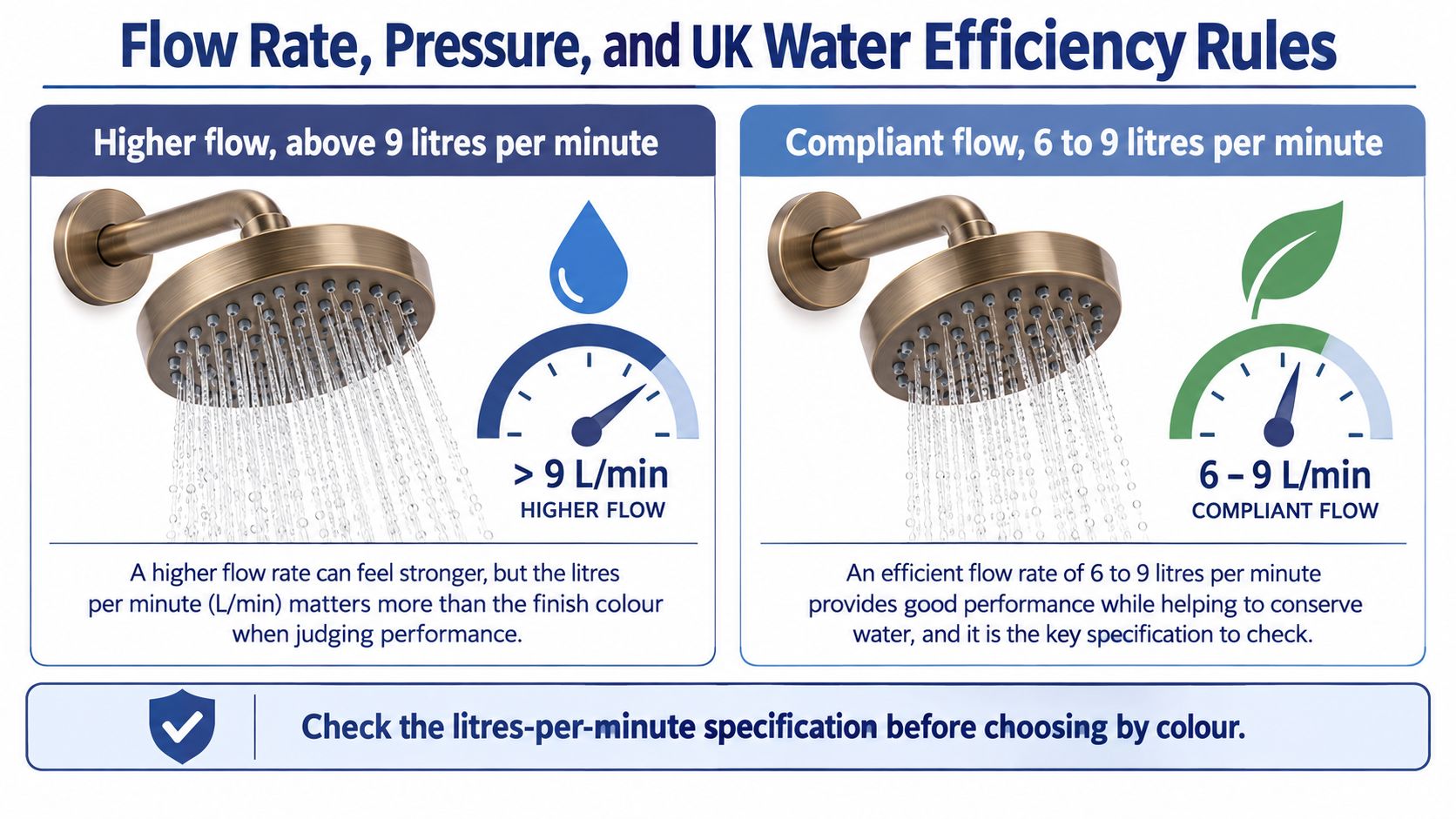
A brushed bronze shower head should be judged by its flow rate first and its finish second. UK government guidance distinguishes standard shower heads, typically using 10 to 15 litres per minute, from lower-flow models using about 6 litres per minute, and the Energy Saving Trust gives an ordinary mixer shower head benchmark of around 8 litres per minute UK government water-efficiency guidance.
Why pressure changes everything
Flow changes with pressure, so a head that performs well in one house can feel weak or wasteful in another. The UK low-flow specification defines a low-flow shower head as producing a fully formed spray at no more than 8 litres per minute under pressures up to 5 bar UK low-flow and efficiency criteria.
The tested flow curve matters more than the brochure line. A product should be assessed at the system's dynamic pressure, not at a showroom assumption that may never match the house.
What I ask for on a renovation job
A manufacturer sheet should show the minimum pressure needed for a complete spray pattern, whether a regulator is supplied, and what flow the head delivers at the pressure the property has. The government's low-flow criteria require the regulator to be sold with the head when it is needed to keep the flow limit at 5 bar.
During commissioning, a timed discharge into a calibrated container is more useful than judging the spray by eye. That sounds unglamorous, but a timed discharge into a calibrated container is the only way to confirm the shower is efficient rather than just advertised that way.
For a Kent renovation, that measurement belongs in the handover notes. It gives you a clear reference if the customer later reports a change in performance or a rise in hot-water use.
Brushed Bronze Versus Chrome in UK Hard-Water Bathrooms
Chrome still has its place. It's bright, familiar, and easy to match, which is why it's so common. Brushed bronze, though, often makes more sense in homes where people care about a warmer look and don't want every water mark shouting for attention.
What each finish hides, and what it doesn't
The main difference in hard-water bathrooms is visibility. A brushed bronze surface can make spots and early scale less obvious than polished chrome, but that's concealment, not prevention. Limescale still builds, because the minerals in the water don't care what colour the head is.
That's the mistake I correct most often. People assume a brushed finish means less cleaning, when what it really means is that some deposits are less noticeable for a while. If the household won't wipe the fitting down, scale still wins in the end.
Practical comparison for a Folkestone bathroom
| Finish | Hard-Water Visibility | Cleaning Routine | Best For |
|---|---|---|---|
| Brushed Bronze | Spots and light scale are less obvious | Gentle wiping, careful descaling, prompt drying | Homeowners who want warmth and can keep up with routine care |
| Chrome | Water marks show quickly | Frequent wiping to keep the shine | Bathrooms where a bright, classic finish is preferred |
| Other brushed finishes | Usually better at hiding marks than polished metals | Still needs finish-safe cleaning | Renovations that prioritise visual softness over mirror shine |
If you live in a hard-water area and dislike constant polishing, brushed bronze can be the more forgiving visual choice. If you want every trace of residue to stand out so you spot problems early, chrome does that job well.
The question isn't which finish is “easier” in the abstract. It's which one fits the way the household lives. Some clients don't mind a cloth-and-dry routine after a shower. Others want a finish that looks acceptable even when life gets busy. The right answer depends on which camp the bathroom belongs to.
Compatibility with Electric, Mixer, and Pumped Shower Systems
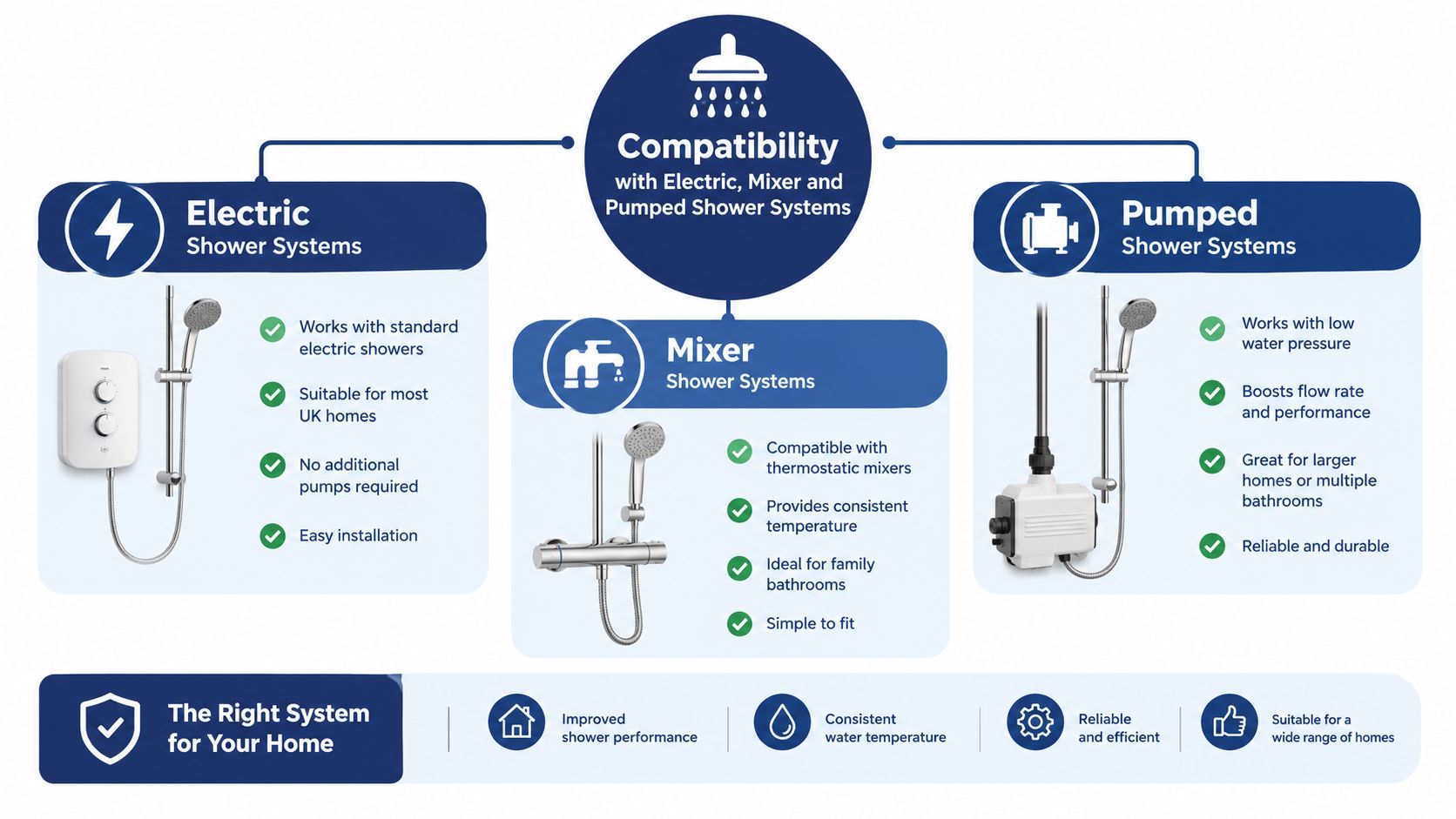
A brushed bronze shower head has to match the shower system already in the house. That is where a lot of bad installs start, because electric, mixer, and pumped systems work at different pressures and flow rates.
Know the system before you buy
UK shower research showed electric showers commonly ran at 3 to 8 litres per minute, mixer showers without pumps at 5 to 15 litres per minute, and pumped showers at 10 to more than 20 litres per minute United Utilities and Waterwise shower research. Those ranges explain why one head can feel spot on in one bathroom and disappointing in another.
The same research project found 4,270 shower events in 233 unmetered homes across England. The average shower used 26 litres over roughly six minutes, at a typical flow rate of 5 litres per minute. That spread is useful on site because it shows how much real showers vary from one household to the next.
The compatibility checklist I use
- Identify the shower type: Electric, mixer without a pump, or pumped, because the flow characteristics differ.
- Check connection size: A decorative finish does nothing if the connection will not fit the arm or outlet.
- Confirm stated flow at standard pressure: Do not rely on showroom language alone.
- Ask about the spray pattern: A full, even spray matters more than a decorative droplet effect.
- Verify pressure needs: The head must suit the actual system, not an idealised brochure setup.
A note for anyone tempted by a head described as “high pressure”. That phrase means little unless it is tied to the conditions in your bathroom.
Electric showers need particular care, because they already run at comparatively low flow rates. A bronze finish will not rescue a poor technical match, and it will not fix a valve that was never set up to feed the new head correctly.
Maintenance Routine for Brushed Bronze Shower Heads
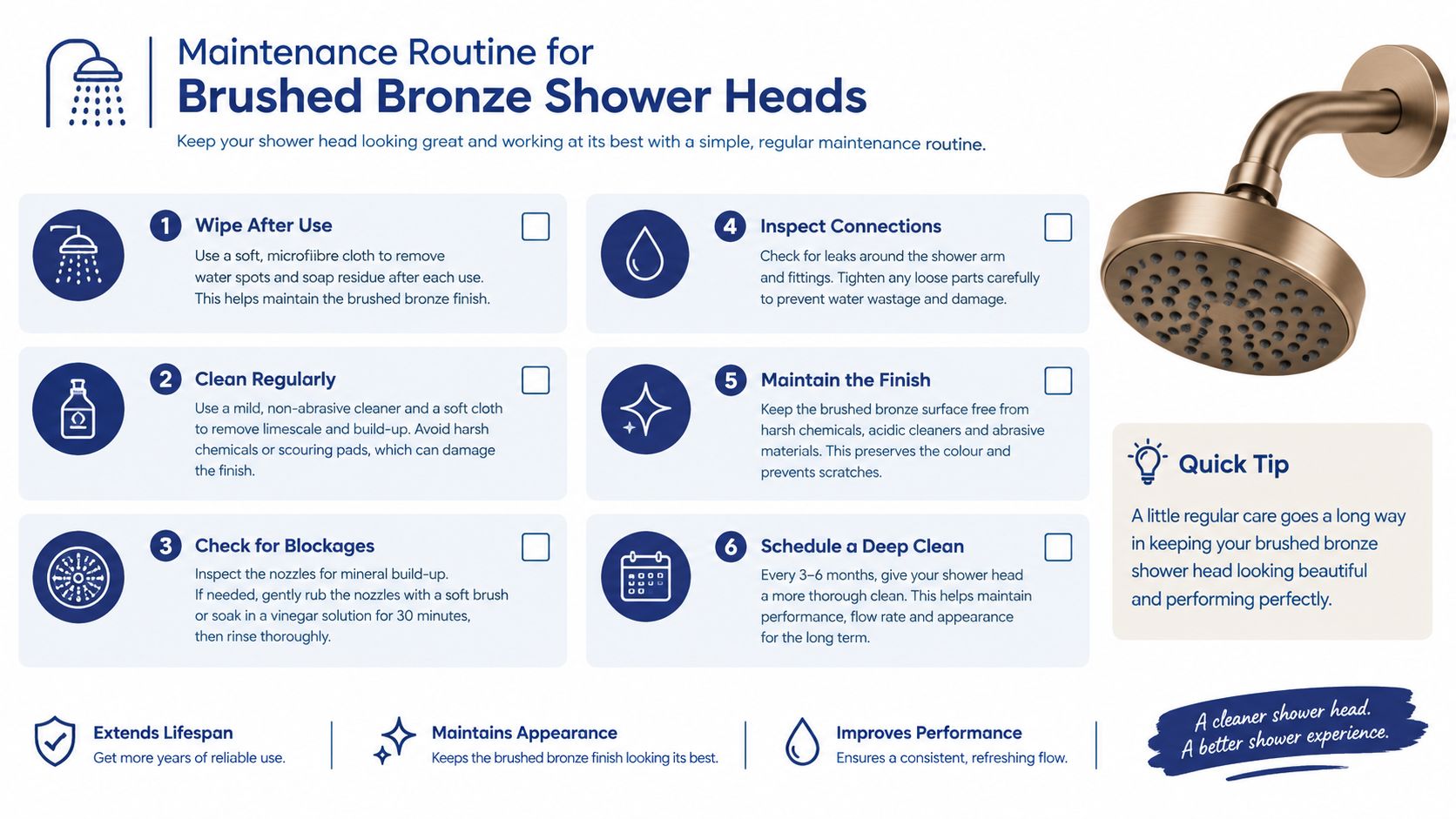
A brushed bronze shower head stays attractive when the routine is gentle and consistent. The winning approach is boring on purpose, because aggressive cleaners and heavy scrubbing are what shorten the life of a decorative finish.
What to do after installation
Start by recording the initial flow rate at a defined pressure. That gives you a baseline, and it turns later complaints into a measurable issue instead of a vague one. If the reading drops significantly, you can look for blocked nozzles, an inlet filter problem, or pressure deterioration.
Use only finish-safe cleaning methods. Warm soapy water, a soft cloth, and prompt drying are the safest defaults. Avoid abrasive pads, bleach, and acidic products unless the manufacturer explicitly approves them for that coating.
The maintenance points that matter
Elastomer nozzles are useful because they can be flexed clean, which helps in homes where limescale builds quickly. Accessible filters are just as important, because they let you deal with debris without taking the fitting apart unnecessarily.
A good shower head should be easy to maintain without special tools or risky chemicals.
That's why I prefer serviceable details over hidden ones. If the head can't be cleaned or inspected without damaging the finish, it's working against the homeowner, not for them.
For a wider bathroom refit, it also helps to keep access sensible around the fitting, just as you would with other service points shown in leaking shower tray. Hidden faults are cheaper to prevent than to chase later.
Repeat the flow check periodically, especially in hard-water homes. A clear decline tells you something has changed long before the customer starts complaining about weak spray or patchy coverage.
Choosing the Right Brushed Bronze Shower Head for Your Renovation
A brushed bronze shower head can suit a room well and still perform badly if the plumbing behind it is wrong. Start with the system, then check pressure and flow, then decide whether the finish suits the space better than chrome or another option.
Use this sequence before you buy
- Start with the plumbing: Electric, mixer, or pumped.
- Check the pressure: The head has to produce a usable spray at the pressure you have.
- Review water efficiency: Compare the litres-per-minute figure, not the colour name.
- Think about cleaning habits: If the household will not dry the fitting down, choose a finish and coating that can handle that reality.
- Confirm temperature control: A decorative head does not solve unsafe water temperatures.
Scalding risk has nothing to do with finish. HSE guidance identifies water above 44°C as a scalding risk for vulnerable people and recommends thermostatic mixer valves where temperatures could reach showers; it also says controls must be monitored and maintained HSE scalding guidance. UK guidance recommends thermostatic control around 39 to 43°C for showers, with hotter water stored for hygiene and blended at the point of use.
I treat the shower head as one part of a wider system. It has to work with safe temperature control, the available pressure, and the rest of the bathroom without creating weak spray or constant complaints.
The finishing details around it matter too. A matched seal, trim, and edge treatment can make the installation look deliberate rather than patched together, especially in a wet room or a carefully detailed enclosure. If you are still deciding how the waterproofing around the shower area will be finished, bathroom waterproofing tape is a good reminder that small components often decide how long a bathroom stays sound.
If you are planning a bathroom renovation in Folkestone or Kent and want the shower to look right without causing performance headaches, Seby Bathroom Renovation can help you spec the right fittings from the start. Visit Seby Bathroom Renovation to discuss a shower upgrade that balances finish, flow, and long-term reliability.
Produced via the Outrank app